
CS2 Float Values Explained: How They Affect Skin Prices Today
A skin can be Factory New, look clean in-game, and still be worth noticeably more or less than another copy of the exact same finish. The reason is often its CS2 float value. This number controls wear and can strongly influence collector demand, especially for rare skins, knives, gloves, and unusually low- or high-float items.
Featured Snippet: What Is a CS2 Float Value?
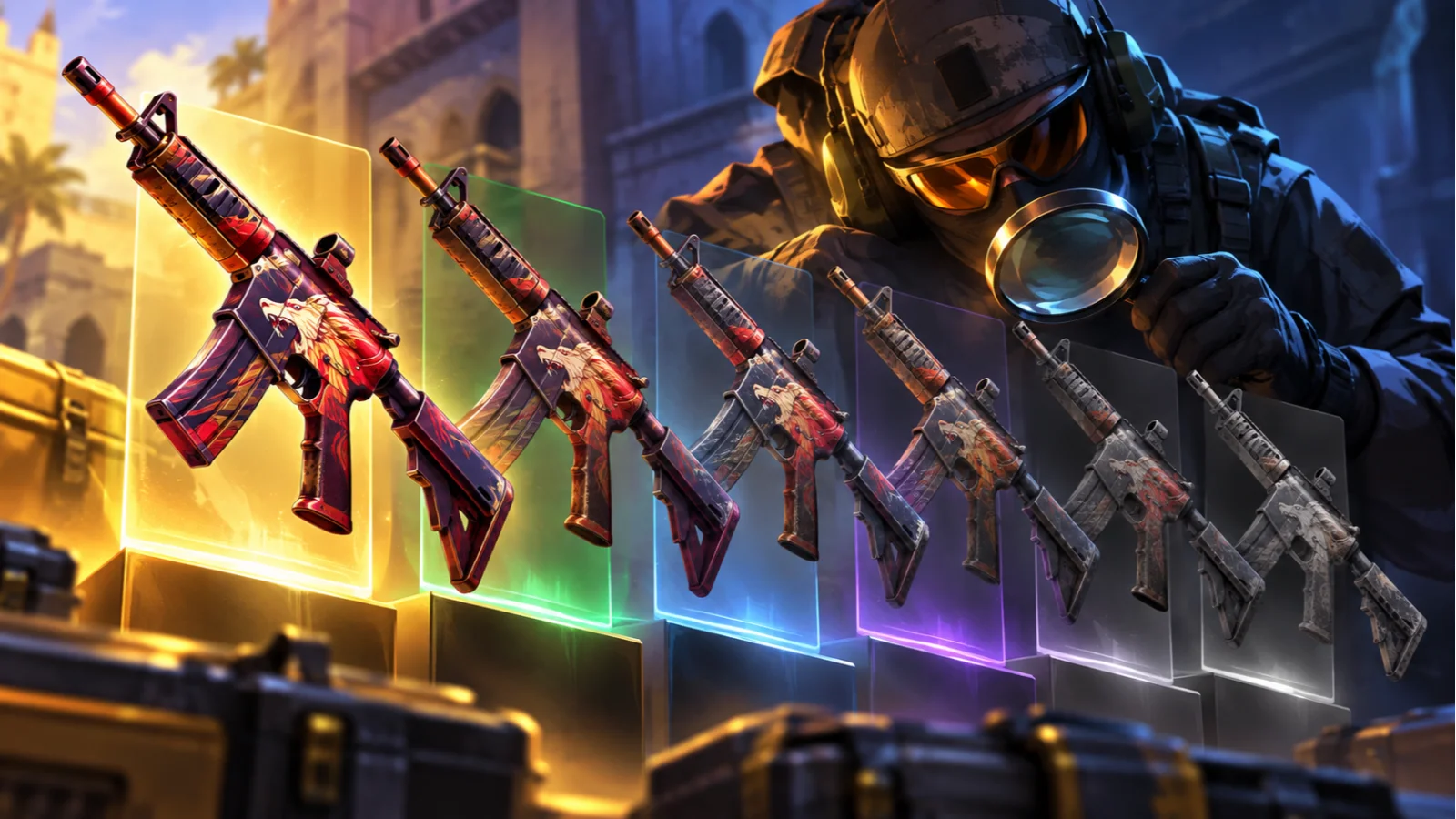
A CS2 float value is a number assigned to a weapon skin that determines its wear. Lower floats generally mean less visible wear, while higher floats usually produce more scratches, fading, or other finish-specific changes. Standard wear categories run from Factory New to Battle-Scarred, but each individual skin has its own minimum and maximum possible float range.
WearStandard Float Range
Factory New (FN)
0.00–0.07
Minimal Wear (MW)
0.07–0.15
Field-Tested (FT)
0.15–0.38
Well-Worn (WW)
0.38–0.45
Battle-Scarred (BS)
0.45–1.00
These are the standard wear boundaries. They don't mean every skin can exist across the full 0.00–1.00 range.
How CS2 Float Values Actually Work
Every eligible CS2 weapon finish has a wear value commonly called its float. Think of it as a more precise version of the familiar FN, MW, FT, WW, and BS labels.
Two AK-47 skins can both be Field-Tested while having very different floats. One might sit just above the Minimal Wear boundary, while another could be close to Well-Worn.
That difference can affect both appearance and price.
There's another important detail: skins have individual float caps. A finish might have a possible range of 0.00–0.70, 0.10–0.70, or something completely different. If a skin's minimum float is above 0.07, for example, a Factory New version simply cannot exist.
That makes checking the finish itself just as important as memorizing the five standard wear tiers.
How Float Values Affect CS2 Skin Prices
There isn't a universal multiplier for float.
A 0.01 skin isn't automatically worth twice as much as a 0.05 version, and Factory New doesn't automatically command the same premium across every finish.
Instead, the market tends to price float through a combination of appearance, rarity, supply, collector interest, and the skin's normal trading range.
1. Lower Float Can Mean a Cleaner Skin
For many finishes, lower wear produces fewer scratches and cleaner artwork.
That can make low-float copies more desirable. A regular player might simply choose the cheapest Factory New listing, while a collector may specifically search for a 0.00x float.
The difference becomes especially relevant when the skin visibly deteriorates with wear.
2. Extreme Floats Can Carry Collector Premiums
Collectors don't only chase low floats.
Extremely high-float skins can also be interesting because they're close to the maximum possible wear. Some players deliberately build Battle-Scarred inventories or collect skins with unusually high values.
So "lower float = better" works as a basic description of wear, but it isn't a complete pricing rule.
3. Wear Boundaries Matter
Imagine two copies of the same finish with floats of 0.149 and 0.151.
Numerically, they're almost identical. Market-wise, however, they're separated by the Minimal Wear/Field-Tested boundary.
That can create a meaningful price difference because buyers commonly filter marketplace listings by wear category rather than exact float.
The same principle applies around the FN/MW, FT/WW, and WW/BS thresholds.
4. Float Premiums Depend on the Skin
Don't pay a huge low-float premium without checking whether buyers actually care about float on that particular finish.
For something like an AK-47 | Redline, which doesn't come in Factory New, low-float Field-Tested examples can attract extra attention. Other skins may show relatively small visual differences across part of their available wear range.

Pro tip: Compare the skin against other listings with similar floats—not just the cheapest listing in the same wear category.
Float vs. Wear: What's the Difference?
Wear is the category. Float is the exact number behind it.
For example, two skins labeled Minimal Wear could have floats close to opposite ends of the MW range. They're technically the same wear tier but aren't necessarily equivalent to collectors.
FactorWhat It Tells You
Wear tier
General condition: FN, MW, FT, WW, or BS
Float value
Exact wear value
Pattern/seed
Pattern placement or variation where applicable
Finish
The actual skin design
StatTrak
Whether the item tracks kills
Stickers
Additional customization that may affect value
A good price check considers these factors together rather than treating float as the only variable.
CS2 Float Value vs. Pattern Seed
Float and pattern seed are separate properties.
Float determines wear. Pattern seed controls how a pattern is positioned or generated on finishes where pattern variation matters.
This distinction becomes especially important with skins such as Case Hardened. Two examples with similar floats can look dramatically different because their patterns aren't the same.
Likewise, Doppler knives are usually discussed by phase or special appearance alongside their wear. A low float can be desirable, but it doesn't transform one Doppler phase into another.
[Placeholder: CS2 Pattern Guide → URL]
Does Float Affect Stickers?
Not in the same way.
The weapon's float controls the skin's wear, while applied stickers have their own characteristics. A low-float weapon doesn't automatically make an ordinary sticker combination valuable.
For expensive crafts, buyers may consider the complete package: base skin, float, pattern, sticker type, sticker placement, and the condition of applied stickers.
This becomes particularly important with collectible crafts involving older stickers such as Katowice 2014 holos.
[Placeholder: CS2 Sticker Guide → URL]
Does StatTrak Change Float?
No. StatTrak and float are separate attributes.
A StatTrak skin can have the same possible float range as its non-StatTrak counterpart. What changes is the item's variant and market supply—not the basic meaning of its wear value.
When comparing prices, compare like with like:
StatTrak FN vs. StatTrak FN, rather than StatTrak FN vs. regular FN.
Otherwise, it's easy to mistake a StatTrak premium for a float premium.
How to Check a Skin's Float in CS2
The safest habit is to inspect the individual item before buying it.
Steam inventory and marketplace inspection links can provide item-specific information, while specialized databases and marketplaces often make exact float values easier to compare across listings.
For serious purchases, check:
Exact float value.
Minimum and maximum float available for that finish.
Pattern/seed if relevant.
Comparable listings with similar floats.
Recent sales where reliable data is available.
Stickers or other item-specific characteristics.
Don't rely on the wear label alone.
What Is a "Good" Float in CS2?
There's no single good float for every skin.
If you simply want a clean play skin, an inexpensive example that looks good in-game may be enough. Paying extra to move from 0.04 to 0.01 makes little sense if you can't see the difference and don't care about collector value.
Collectors approach the question differently. They might specifically target 0.00x Factory New items, unusually low floats for finishes that can't reach FN, or extremely high Battle-Scarred floats.
The important question isn't just "How low is the float?"
It's "Does this float make this particular item more desirable?"
When Is a Low-Float Skin Worth More?
Low float tends to matter most when several conditions overlap.
The skin needs collector demand, the float should be meaningfully unusual, and buyers should actually pay premiums for comparable examples.
Scarcity also matters. A theoretically impressive float isn't automatically valuable if there's little demand for the underlying skin.
This is why marketplace research beats simple rules like "buy anything below 0.01."
Can High-Float Skins Be Valuable?
Absolutely.
Certain Battle-Scarred skins have distinctive appearances that some players prefer. Extreme high floats can also appeal to collectors chasing unusual rankings or inventories built around heavily worn finishes.
Visual behavior is skin-specific, too. Higher wear doesn't affect every finish in exactly the same way.
That creates a niche market where the "worst" conventional condition can sometimes be the exact version somebody wants.
Float Isn't the Only Factor That Determines Price
One of the easiest trading mistakes is reducing a skin's value to a single decimal number.
Consider an item as a combination of attributes:
Skin and weapon: Demand for the base finish matters first.
Wear and float: Cleaner or extreme examples may command premiums.
Pattern/seed: Critical for certain pattern-based finishes.
StatTrak: A separate variant with different supply and demand.
Stickers: Rare crafts can significantly change how buyers evaluate an item.
Liquidity: A theoretical premium isn't useful if nobody is willing to pay it.
For example, an attractive Case Hardened pattern can matter more than a small float difference. A collectible sticker craft may also require individual valuation rather than comparison against vanilla marketplace listings.
Common Float Mistakes
The first mistake is assuming all Factory New skins are equal. A regular FN example and an exceptional low-float FN can target different buyers.
The second is assuming lower always means more expensive. That ignores high-float collectors, special wear appearances, patterns, stickers, and market demand.
Another common error is paying a collector premium without checking comparable sales. A seller can list a 0.00x skin at any price they want. A listing price doesn't prove the market values it there.
Finally, don't confuse rarity with liquidity. An unusual float may be genuinely rare while still taking a long time to sell at a premium.
Buying CS2 Skins by Float: Practical Checklist
Before buying an expensive skin, answer a few basic questions:
Is the float unusual for this specific finish?
Does lower wear noticeably improve its appearance?
Are similar-float examples actually selling at a premium?
Does pattern matter more than float on this finish?
Are stickers influencing the asking price?
Is the premium worth paying for your goal: playing, collecting, or trading?
If you can't explain why the exact float deserves a premium, don't assume it does.
[Placeholder: How to Buy CS2 Skins Safely → URL]
Key Takeaways
CS2 float values determine the exact wear of weapon skins and place them within FN, MW, FT, WW, or BS categories.
Lower float often means a cleaner appearance, but it doesn't guarantee a fixed price premium.
Every finish has its own possible minimum and maximum float.
Extremely low and extremely high floats can both attract collectors.
Pattern/seed, StatTrak, stickers, supply, and liquidity can matter as much as—or more than—float.
Compare similar items and real market activity before paying a premium for an unusual float.
Prices and liquidity change—check current offers at the time of reading.
FAQ
What is the best float value in CS2?
There isn't one universal best float. Lower values generally mean less wear, but the most desirable float depends on the skin, its available range, appearance, rarity, and what collectors are currently buying.
Is 0.01 float good in CS2?
For a skin capable of reaching that range, 0.01 is a low Factory New float. Whether it deserves a substantial price premium depends on the specific finish and comparable market activity.
Does lower float always mean a higher price?
No. Lower float can increase desirability, but CS2 skin prices also depend on the finish, pattern, stickers, StatTrak status, supply, demand, and liquidity.
Can a Field-Tested skin have a valuable float?
Yes. A low-float FT skin can be desirable, particularly when the finish cannot exist in Minimal Wear or Factory New, or when it sits very close to the MW boundary.
Does float change when you use a CS2 skin?
No. Using a weapon skin in matches doesn't gradually increase its float. Its assigned wear value remains unchanged.
Why are some Battle-Scarred skins expensive?
Battle-Scarred doesn't automatically mean worthless. Rare base skins remain rare regardless of wear, while certain high-float examples have distinctive appearances or appeal specifically to collectors. CS2 float values are one part of the item's price—not the entire market.