
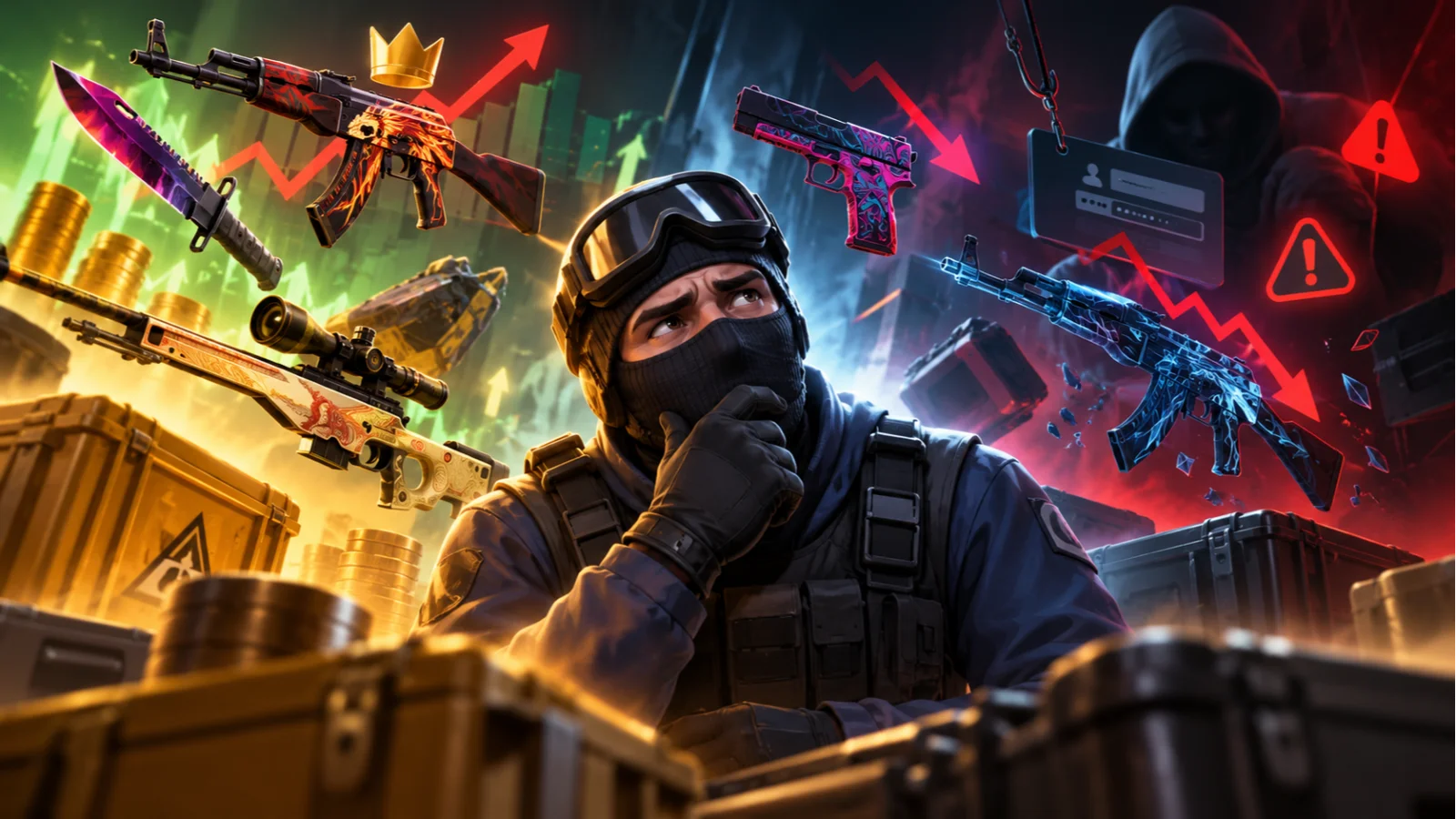
Top 5 CS2 Skin Investing Mistakes and How to Avoid Them
CS2 skin investing can reward patience and good research, but the market is far less predictable than it sometimes looks. The biggest CS2 skin investing mistakes usually come from chasing hype, ignoring float and liquidity, taking unnecessary security risks, or trading without a plan. Here are five traps worth avoiding before you put serious money into skins.
Featured Snippet: What Are the Biggest CS2 Skin Investing Mistakes?
The most common CS2 skin investing mistakes are buying during short-term hype, ignoring float and pattern differences, using unsafe trading methods, concentrating too much value in one item, and making emotional decisions. Successful traders usually compare listings, inspect individual skins carefully, consider liquidity, protect their Steam accounts, and decide on an exit strategy before buying.
1. Buying Skins Because They Are Hyped
New cases, major updates, streamer attention, and sudden community trends can create huge demand for specific skins.
That does not automatically make them good investments.
Fresh items often trade in an unstable market because supply and demand are still developing. A skin can look incredibly desirable during its first days of trading and become much easier to buy later as more copies reach the market.
The Revolution Case is a useful example of why investors should separate excitement around a release from the long-term fundamentals of individual items.
Why hype buying is risky
FOMO makes it easy to focus on recent price movement rather than the item itself. Before buying, ask what could support demand after the initial excitement disappears.
Check:
Collection or case availability
Historical trading activity
Current listing depth
Float distribution
Pattern or finish variations
StatTrak availability
Long-term visual popularity
There is no universal rule saying you should wait a specific number of days after a release. Some markets settle quickly, while others remain volatile for much longer.
Pro tip: Build a watchlist before buying. Watching an item for a while can tell you much more than reacting to one sharp price move.
[Placeholder: CS2 Cases Guide → URL]
2. Ignoring Float, Pattern, and Other Skin Details
One of the most expensive CS2 skin investing mistakes is treating every copy of a skin as interchangeable.
They aren't.
Wear tiers such as Factory New, Minimal Wear, Field-Tested, Well-Worn, and Battle-Scarred provide a useful starting point, but float can create meaningful differences within the same wear category.
Two Factory New copies may therefore attract different buyers.
Float matters, but it isn't everything
A lower float can command additional interest, particularly when collectors care about exceptionally clean examples. But buying the lowest float you can find is not automatically the best strategy.
You also need to consider how much of a premium other buyers are willing to pay.
The same principle applies to pattern-dependent finishes. Certain Case Hardened patterns, Crimson Web placements, Fade percentages, and Doppler phases can trade differently from ordinary versions of the same skin.
Sticker combinations complicate valuation even further.
A skin carrying desirable Kato 2014 holo stickers, for example, cannot be valued simply by adding the unapplied sticker prices to the base skin. Placement, combination, weapon, wear, and collector demand all matter.
What to inspect before buying
Always check the exact item rather than relying only on its market name.
Look at its float, pattern/seed, sticker placement, StatTrak status, wear and actual in-game appearance. For expensive or unusual items, compare several similar examples before deciding whether a premium makes sense.
An AWP | Dragon Lore is a good example: condition matters, but Souvenir status, stickers and the characteristics of the individual copy can dramatically change how buyers evaluate it.

[Placeholder: CS2 Float Guide → URL]
3. Taking Unnecessary Security Risks
Investment returns mean very little if you lose the inventory.
Phishing pages, impersonators, fake trading sites and fraudulent Steam login screens remain important risks for anyone trading valuable CS2 items.
Be especially suspicious when someone sends you a link and asks you to sign in, verify your inventory, vote for a team, check an item or complete a trade through an unfamiliar service.
Protect the account first
Use Steam's available account-security features and carefully verify trade confirmations.
Never give another person your password, authentication codes or other account credentials. Check domains manually instead of trusting links from strangers, Discord messages or search advertisements.
For high-value trades, slow down.
Confirm exactly which items are being exchanged and verify the trade again before accepting it.
If a deal requires unusual steps or creates artificial urgency, walking away can be much cheaper than discovering why afterward.
[Placeholder: CS2 Trading Security Guide → URL]
4. Building a Portfolio With No Diversification or Liquidity Plan
Owning one expensive item can be exciting. It also means your portfolio depends heavily on what happens to that single item's market.
Consider an M4A4 | Howl. It has exceptional recognition and scarcity characteristics, but that does not mean every investor should concentrate most of their inventory value in one.

Expensive collector skins can also be harder to sell quickly at the price you want.
Diversification isn't just about owning more skins
A portfolio containing ten nearly identical items may still be highly concentrated.
Instead, investors can consider exposure across different types of CS2 cosmetics, such as:
CategoryMain Factor to Watch
Liquid play skins
Consistent buyer demand
Rare collector skins
Scarcity and buyer depth
Cases
Supply and opening demand
Stickers
Event, team and player demand
Souvenir items
Provenance and collector interest
StatTrak skins
Demand for the specific weapon/finish
There is no ideal percentage allocation that works for everyone. Portfolio structure should depend on budget, risk tolerance, liquidity needs and how actively you want to trade.
A rare skin with a spectacular theoretical valuation is not especially useful if finding a buyer at that valuation takes months.
5. Trading Emotionally Instead of Following a Plan
CS2 prices can move quickly. That makes emotional trading particularly dangerous.
A sudden drop can trigger panic selling. A sudden rally can trigger FOMO buying. A skin that has already lost value can tempt you to hold indefinitely simply because you don't want to realize the loss.
None of these decisions necessarily reflects what the item is worth now.
Decide why you're buying before you buy
Write down your investment thesis.
Maybe you expect supply to decline. Perhaps you believe the finish has durable play-skin demand. Maybe you're buying an older collectible because its characteristics are difficult to reproduce through newer content.
Then decide what would prove that thesis wrong.
This makes it easier to distinguish normal market volatility from a genuine change in the reason you originally bought the item.
Don't assume every legacy skin must appreciate over several years. CS2 cosmetics remain speculative digital items, and Valve updates, market conditions, player preferences and changes in supply can all affect demand.
Bonus Mistake: Comparing Prices Without Comparing Markets
A skin's displayed price is not necessarily the amount you can actually receive for it.
Steam Community Market values, third-party marketplace listings and direct cash valuations can differ because the markets have different fee structures, payment systems, liquidity and buyer populations.
This creates a common valuation mistake: seeing the highest available listing and treating it as the item's real cash value.
Look at executable prices
When possible, examine recent transactions and realistic buy/sell levels rather than one optimistic listing.
For unusual items—rare patterns, extremely low floats or expensive sticker crafts—standard market comparisons become even less reliable.
The question isn't only:
"What is this skin listed for?"
It is also:
"How many buyers are realistically willing to pay that amount?"
That distinction becomes increasingly important as item value and rarity increase.
A Better CS2 Skin Investing Checklist
Before buying a skin as an investment, check the item itself and the market around it.
Understand the supply source. Is the case, collection or item still entering circulation?
Inspect the exact skin. Check wear, float, pattern/seed, stickers and StatTrak status.
Compare realistic market prices. Don't rely on a single listing.
Check liquidity. Consider how easily you could sell the item.
Protect your account. Verify every login, domain and trade.
Define your thesis. Know why you're buying and what could invalidate that reasoning.
Avoid FOMO. A rapidly rising price isn't evidence that it will continue rising.
Prices and liquidity change—check current offers at the time of reading.
Key Takeaways
Buying into short-term hype is one of the most common CS2 skin investing mistakes.
Float matters, but pattern, stickers, wear and collector demand can matter just as much.
Account security should be treated as part of investment risk management.
Diversification can reduce dependence on the performance of a single skin or market segment.
Liquidity matters: an impressive listing price doesn't guarantee you can sell at that level.
CS2 skins are speculative assets, so no skin or strategy guarantees a profit.
FAQ
Is investing in CS2 skins profitable?
It can be profitable, but returns are never guaranteed. Skin prices depend on supply, demand, game updates, collector interest and broader market conditions. Transaction fees and liquidity also affect real returns.
What is the biggest mistake when investing in CS2 skins?
Buying without understanding the individual item is one of the biggest problems. Investors should examine float, wear, pattern, stickers, supply, demand and liquidity instead of relying purely on recent price movement.
Does lower float always make a CS2 skin more valuable?
No. Lower floats can attract premiums, especially for collectible examples, but the size of that premium depends on the skin and buyer demand. Paying substantially more for a low float only makes sense if the market recognizes that difference.
Are rare CS2 skins always good investments?
No. Rarity alone does not guarantee demand or liquidity. A very rare item can still be difficult to sell if few collectors want it at the asking price.
Should I invest in skins, cases, or stickers?
Each has different supply and demand dynamics. Skins can have play and collector demand, cases depend heavily on supply and opening activity, while stickers may be influenced by teams, players, tournaments, crafts and remaining supply.
How can I avoid CS2 skin investing mistakes?
Research every purchase, inspect the exact item, compare multiple markets, understand liquidity, secure your Steam account and avoid making decisions purely because of hype or short-term price movements. A disciplined process won't eliminate risk, but it can prevent many avoidable mistakes.